All pages referring or tutorials for generic Networking.
Introduction to Networks
This page is an introduction to Networks. We don’t need to know everything about it, but often face it in our work. In this guide I will…
This page is an introduction to Networks. We don’t need to know everything about it, but often face it in our work. In this guide I will give you a basic understanding of networks, IP addresses, VLANs, Segmenting etcetera. Basically everything you need to understand the process, and hopefully even more than that.
Requirements
- Some basic networking knowledge
- Some basic subnetting knowledge
- Around 20 minutes of your time
Introduction to Networking
Networking is the process of connecting devices to share data and resources. It allows communication between users over local or global distances. Networks can range from small home setups to large corporate infrastructures. Key components include routers, switches, and protocols that manage data traffic. Effective networking ensures reliable, secure, and efficient information exchange. As technology advances, networking plays a critical role in enabling digital communication worldwide.
Logically this means that every device will have an IP address and this can be used to communicate with other devices. This can look like the diagram below:
This shows a simple network with 8 devices, all connected to each other. In practice, the circle will represent the infrastructure; the Routers and Switches.
Routers
In every network, we have a device that plays the “Router” role. This is basically connecting different networks to each other. In most bigger networks, this can be the firewall.
On Azure, the routing and switching part is done with creating a virtual network. This means that this is all managed and you only select the network you want to connect with.
Switches
Switches are the distribution part of a network. These are literally like power strips but then for networks. One cable goes in (called the “Uplink)”, and all other cables are going out of the switch (called “Downlinks)”. Connecting a device to a downlink of a switch gives access to the network.
Routers and Switches can seem the same as terms but they are different in a particular way. Routers connects our devices to different networks, and Switches redistribute those networks.
IP addressing
IP addresses are needed on a network for every device to know where to deliver a package. You can compare this like in a real world city, where every street has a name and every house has a house number. IP addressing works kind of the same way, but translated in a way so computers can also work with it.
We have two types/versions of IP addresses:
- IPv4, where we will focus on in this guide
- IPv6, for more information about IPv6 I recommend first understand IPv4 and then read this guide: https://justinverstijnen.nl/basic-ipv6-explaination/
IP address are built in this way:
The first part represents the “Network ID”, which is a static part and will remain till configured different. The last part represents the “Host ID” which is a number that is different for every host. The Network ID can be compared to a real life Street and the Host ID is the house number.
Class A, Class B and Class C networks
Now this is a basic explaination of a Class C address, where we only use the last number. We have 3 classes that we use in networking:
- Class A (255.0.0.0 to 255.254.0.0)
- Class B (255.255.0.0 to 255.255.254.0)
- Class C (255.255.255.0 to 255.255.255.255)
Now this tells us how many devices we can use in our network:
- In Class A, we can connect millions of devices because there are many available addresses
- In Class B, we can connect up to 65.000 devices
- In Class C, we can connect up to 254 devices
The most important here is the Subnet mask which tells devices on what part of the IP addressing scheme they are.
Introduction to Subnet masks
You must have seen them in your daily life of being an IT guy, Subnet masks. This is a number like:
- 255.255.255.0 or /24
- 255.255.0.0 or /16
This number decides how many hosts we can use in our network. The more zeros in the subnet mask, the more host addresses are available. For example, /24 (255.255.255.0) allows 254 usable hosts, while /16 (255.255.0.0) allows 65.534 usable hosts. Subnet masks help divide networks into smaller parts, making management and security easier. A best practice is always to have your subnets as small as possible for networks or VLANs, but the bottom line is mostly /24.
A smaller subnet is basically a higher performance. Because some requests, like broadcasts are sent to every address. This process is faster to 254 addresses than to 65.000 addresses.
Tip: use my Subnet calculator to calculate your networks: https://subnet.justinverstijnen.nl/
Deep dive into IP addresses
IPv4 addresses, like 172.16.254.1, are decimal representations of four 8-bit binary blocks, known as octets. Each octet ranges from 0 to 255, making every IPv4 address 32 bits in total.
The IP address 172.16.254.1 can be represented in binary format like shown in the picture below:

So an IP address is basically a human readable way of how the devices work under the hood. All based on 0’s and 1’s.
Subnets, Segmentation and VLANs
Subnetting is a technique used in networking to divide a larger IP network into smaller, more manageable subnetworks (subnets). It helps optimize IP address allocation, improve network performance, and enhance security by segmenting traffic.
Each subnet operates as an independent network while still being part of the larger network. By using subnetting, organizations can efficiently manage IP address space, reduce network congestion, and implement better access control.
Subnetting is achieved by modifying the subnet mask, which determines how many bits are used for the network and how many for the host portion of an IP address. Understanding subnetting is essential for network engineers and administrators to design scalable and efficient network infrastructures.
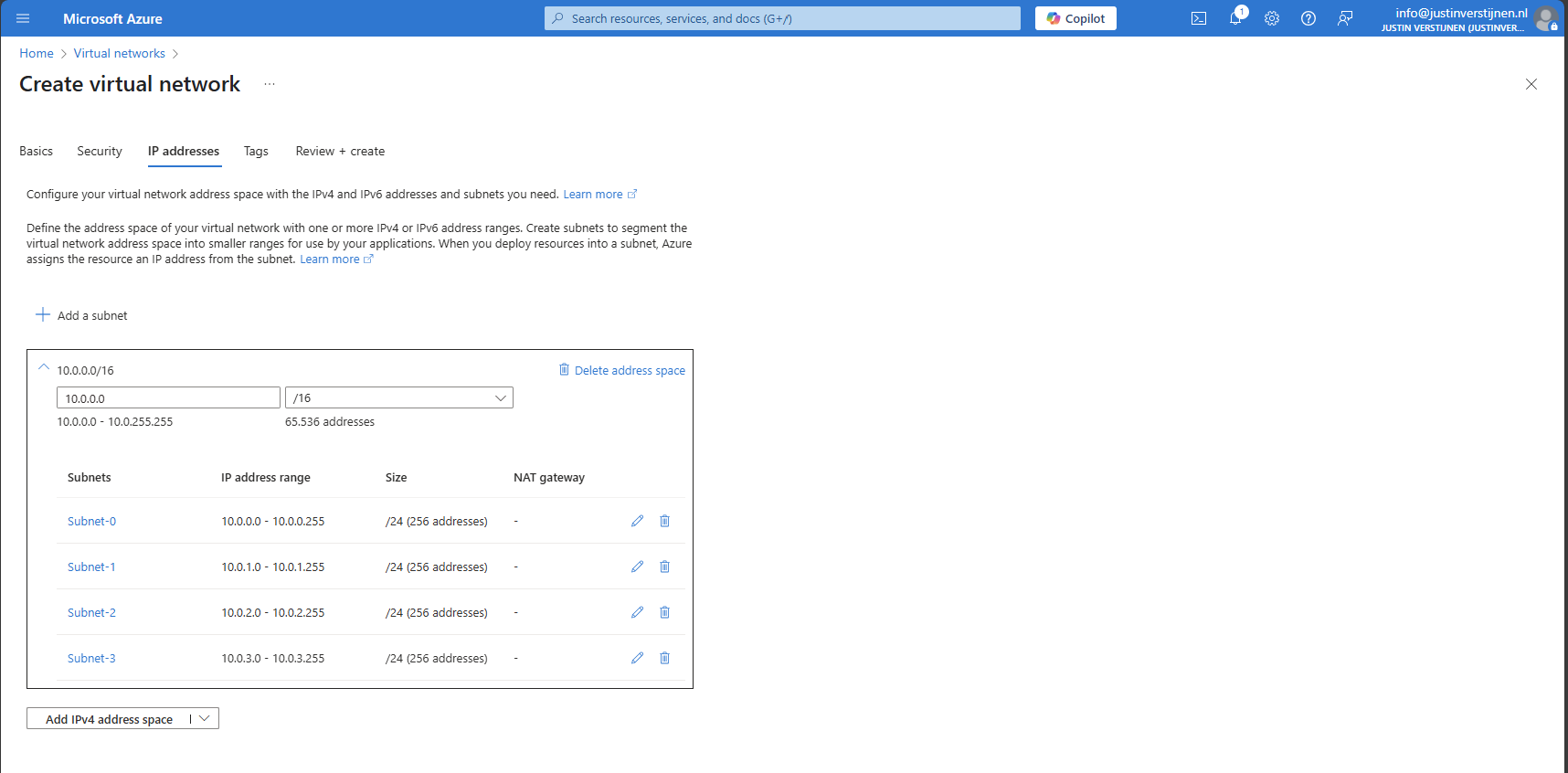
In Azure, we do this by creating a virtual network which has an address space (for example: 10.0.0.0/16) and we can build our subnets in that space (10.0.0.0/24, 10.0.1.0/24, 10.0.2.0/24 etc.). I have done this for demonstration in the picture below:
When using routers and switches, we can segment our network in different, Virtual networks which are called VLANs. This can help us by dividing devices into different isolated networks without the need of having seperate physical networks.
For designing VLANs you have to calculate the subnet sizes and ip address schemes. I have a tool available for doing this:
Tips for understandable network addressing
So when designing networks, you will never know how long you are gonna use it. My advice is to always have a good networking plan and document your plan for future use and expansion.
I have some tips for designing networks that work well:
- Always use as small as possible networks, with /24 as bottom line
- Segment devices with good logic (Servers to servers, Guest to guest etc.)
- Link your VLAN IDs to your Network IDs
- For example;
- VLAN ID 10 to 10.0.10.0/24
- VLAN ID 20 to 10.0.20.0/24
- VLAN ID 99 to 10.0.99.0/24
- For example;
Complete overview of Subnet masks and usable addresses
To have a cheat sheet of subnet masks, I have created a complete table of all usable Subnet masks including how much addresses you can assign in those networks:
| Prefix | Subnet mask | Usable addresses |
|---|---|---|
| Supernets (ISPs) | ||
| /0 | 0.0.0.0 | Used as wildcard |
| /1 | 128.0.0.0 | 2,147,483,646 |
| /2 | 192.0.0.0 | 1,073,741,822 |
| /3 | 224.0.0.0 | 536,870,910 |
| /4 | 240.0.0.0 | 268,435,454 |
| /5 | 248.0.0.0 | 134,217,726 |
| /6 | 252.0.0.0 | 67,108,862 |
| /7 | 254.0.0.0 | 33,554,430 |
| Class A networks | ||
| /8 | 255.0.0.0 | 16,777,214 |
| /9 | 255.128.0.0 | 8,388,606 |
| /10 | 255.192.0.0 | 4,194,302 |
| /11 | 255.224.0.0 | 2,097,150 |
| /12 | 255.240.0.0 | 1,048,574 |
| /13 | 255.248.0.0 | 524,286 |
| /14 | 255.252.0.0 | 262,142 |
| /15 | 255.254.0.0 | 131,070 |
| Class B networks | ||
| /16 | 255.255.0.0 | 65,534 |
| /17 | 255.255.128.0 | 32,766 |
| /18 | 255.255.192.0 | 16,382 |
| /19 | 255.255.224.0 | 8,190 |
| /20 | 255.255.240.0 | 4,094 |
| /21 | 255.255.248.0 | 2,046 |
| /22 | 255.255.252.0 | 1,022 |
| /23 | 255.255.254.0 | 510 |
| Class C networks | ||
| /24 | 255.255.255.0 | 254 |
| /25 | 255.255.255.128 | 126 |
| /26 | 255.255.255.192 | 62 |
| /27 | 255.255.255.224 | 30 |
| /28 | 255.255.255.240 | 14 |
| /29 | 255.255.255.248 | 6 |
| /30 | 255.255.255.252 | 2 |
| /31 | 255.255.255.254 | 0 |
| /32 | 255.255.255.255 | 0 |
Comma’s used in Usable addresses to not be confused with IP addresses ;)
Summary
I hope I gave you a great basic understanding of how networks work and the fundamentals to use networking in Azure. Its part of our jobs and not very easy to start out with.
Thank you for reading my guide and i hope it was helpful.
End of the page 🎉
You have reached the end of the page. You can navigate through other blog posts as well, share this post on X, LinkedIn and Reddit or return to the blog posts collection page. Thank you for visiting this post.
If you think something is wrong with this post or you want to know more, you can send me a message to one of my social profiles at: https://justinverstijnen.nl/about/
If you find this page and blog very useful and you want to leave a donation, you can use the button below to buy me a beer. Hosting and maintaining a website takes a lot of time and money. Thank you in advance and cheers :)

The terms and conditions apply to this post.
The Basics and Benefits of IPv6
We hear it a lot these days and it’s a very common network addressing protocol. On this page I will describe the basics and benefits of IPv6.
IPv6. We hear it a lot these days and it’s a very common network addressing protocol and the successor of the older IPv4, but will not necessarily take over IPv4 100% (yet). On this page I will describe the basics, some tips and the benefits.
Requirements
- Around 15 minutes of your time
- Basic networking knowledge is great
IP addressing with IPv4 and IPv6
When we speak of a network, we speak of a set connected devices (we call them clients/nodes) where each device has its own use. Also there are some fundamental components every network has:
- Router (this device connects your network to other networks like the internet)
- Client
Like i said, your network contains several devices and each devices has to know how to connect to an other device. This will be done using an IP address. Using IP addresses enables you to have a very efficient network in terms of cabling. In the past there some coaxial based networks where every device was physically connected to each other.
You can pretty much compare IP addresses to sending a post card in real life. Your postal company has to know where your postcard must be delivered, but then in terms of finding the right device in your network.
IP addresses examples
An IP address looks like the addresses below:
- 192.168.1.25 or 172.16.4.75 for IPv4
- fd00::1or fd85:28a1:f4fa::1 for IPv6
IPv4 addressing
In the early ages of computers, a digital manner of adressing network devices was needed. After some research IPv4 was born. A very efficient addressing manner which is easily understandable by computers but also for humans. We humans like easy dont we?
The whole IPv4 addresses space contains 32 bits which means there are 4,3 billion (232) different addresses possible. In the early 80’s when IPv4 was founded this was more than enough.
With the rapid increase in devices worldwide, the shortage of IPv4 addresses became increasingly apparent. This is not surprising, considering that the global number of people is nearly twice the number of available IPv4 addresses.
IPv6 addressing
To fulfill the shortage of IP addresses, IPv6 was born in 1998 which has as primary goal to fulfill the requirement of having enough addresses available for everyone. Fortunately, they did not go way over the top and instead used a 128 bits (2128) address space. In this space, the total usable addresses in IPv6 are 340.282.366.920.938.463.463.374.607.431.768.211.456 (340 undecillion).
Try it yourself: IPv6 and my website
Did you know my webserver is accessible though IPv6? You can test this yourself in CMD or Powershell
POWERSHELL
ping -6 justinverstijnen.nlThis will ping my domain-name by using IPv6. The following will be the outcome:
POWERSHELL
Pinging justinverstijnen.nl [2a01:7c8:f0:1142:0:2:ca6:d853] with 32 bytes of data:
Request timed out.
The ping request will fail because my webserver is configured to do so. This for security reasons. Lets continue our IPv6 journey.
Addressing scheme
Both IPv4 and IPv6 use a similar addressing scheme which is similar to your physical home address and number:
| Type | Network ID | Host ID | Full address |
| IPv4 | 192.168.10.0/24 | .25 | 192.168.10.25 |
| IPv6 | fd12:3456:789a::/64 | ::100 | fd12:3456:789a::100 |
A great way to better understand this:
Network ID represents the street, which is the same for all buildings in that street.
Host ID represents the unique number of your building/house, which is different for each building in the same street.
Differences between IPv4 and IPv6 and benefits
Most of the time in our job, a higher number means faster. Unfortunately this is not the case with IPv6. IPv6’s main job is to create more possible addresses. It does have some great advantages because at the time of founding there was more knowledge, like real world scenario’s where IPv4 weak points were.
| Advantage IPv6 | More information |
| Larger address space | IPv6 has more than a million IP addresses available per person on earth and IPv4 has 0,5 IP addresses per person. |
| Better security with IPSec | IPv6 supports built in IPsec where every package is encrypted at sending and decrypted at receiving to prevent an attacker to steal packages and monitor your behaviour online. |
| Easy network setup with SLAAC | IPv4 requires DHCP or static adressing where IPv6 the device can assign a address itself using duplicate detection, router advertisements and auto assignment. |
| No NAT needed | Because we dont need to share IP addresses anymore, the need of NAT is eliminated. You can directly connect on a device (when the firewall is configured to do so of course). |
| Multicast instead of broadcast | In a network, some devices like Chromecast, Sonos and Airplay use broadcast to advertise themselves. This means it sends a package to all devices. Multicast in IPv6 sends only to specified devices to reduce network load. |
Common IPv4 addresses in IPv6
When it comes to compare generic terms in networking, you can use the table below:
| Explaination | IPv4 | IPv6 |
| Localhost address | 127.0.0.1 | ::1 |
| No DHCP server (APIPA) | 169.254.0.0/16 | fe80::/10 |
| Subnet mask | 255.255.255.0 | /64 |
| Types of network routing | Class A, B and C | 1 class |
| Type of notation | Decimal (0-9) with dots . | Hexadecimal (0-9 and A-F) with colons : |
Summary
This page greatly explains how IPv4 and IPv6 addresses and their basics and benefits work, and there is a lot to also tell about. Obviously too much to include on a single page. Also i want the content to be readable and to stay within the best attention span of humans :).
End of the page 🎉
You have reached the end of the page. You can navigate through other blog posts as well, share this post on X, LinkedIn and Reddit or return to the blog posts collection page. Thank you for visiting this post.
If you think something is wrong with this post or you want to know more, you can send me a message to one of my social profiles at: https://justinverstijnen.nl/about/
If you find this page and blog very useful and you want to leave a donation, you can use the button below to buy me a beer. Hosting and maintaining a website takes a lot of time and money. Thank you in advance and cheers :)
The terms and conditions apply to this post.